
The Department of Photonic Sensor Technologies deals with a variety of physico-chemical, mostly light-based, analysis techniques in science, environment, and industry. Using optical methods, being inherently fast and non-invasive, measurement data can be recorded quickly, contact-free, and thus non-destructive. For this reason, optical methods are already the basis for analytical investigations in research laboratories in chemistry, medicine, materials science, engineering, and biotechnology. The department sees thus a central challenge in further developing and implementing optical analysis techniques in industrial processes and applications outside of research laboratories.
Numerous problems are so complex that they cannot be answered on the basis of a single optical technique. The Photonic Sensor Technology department therefore develops system solutions that consist of a combination of different optical techniques or a combination of optical techniques with other technologies. Thus, the photonic sensor technologies department relies on the development of novel optical measurement methods, mainly based on:
- Raman spectroscopy
- IR-absorption spectroscopy
- Fluorescence
In addition, the department has expertise in a complementary method, the ion mobility spectrometry (IMS), which can also be used in, e.g., trace analysis. Moreover, the department explores the possibility of integrated systems. The studies may include thereby following steps:
- Sample pretreatment (separation, enrichment)
- Detection by means of different (optical) sensors
- Data processing (chemometric data analysis, sensor data fusion).
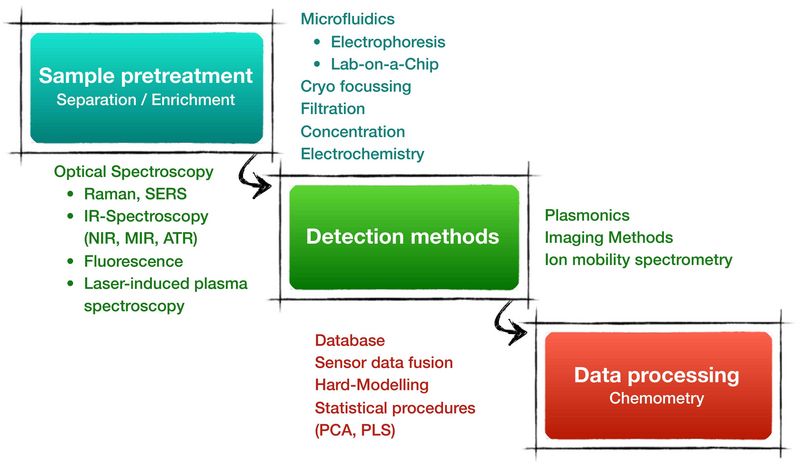
This enables the Photonic Sensor Technologies department to manage complex processes and to develop systems that combine different analytical methods. The main challenges that are thereby tackled are measurement speed, selectivity, and sensitivity.
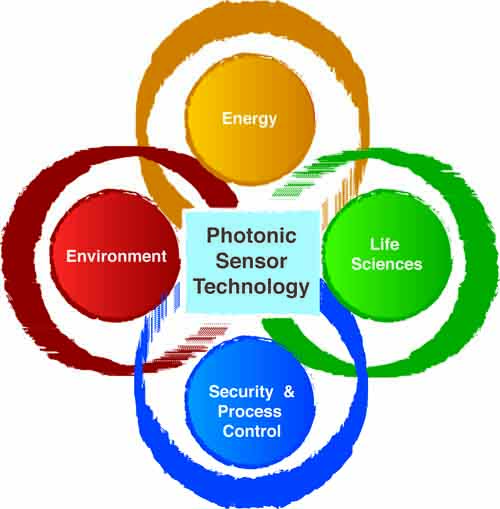
Environment
Due to the increased environmental awareness in society, new regulations are being enacted regarding the use and emission of pollutants, as well as the establishment of new limit values. These serve as an impetus to research new methods for on-site analytics.
Due to society’s growing environmental awareness, new legal regulations regarding the use and emission of pollutants and the specification of new emission limit values are issued. The latter is a driving force for us to explore new methods for on-site analytics.
In the field of gas analysis, for example, the concentration of carbon dioxide and carbon oxide in exhaust gases as well as volatile organic compounds in industrial production processes are investigated.
The contamination of water with microplastics and pharmaceutical residues as well as soils with polyaromatic hydrocarbons (PAH) are further topics with a high socio-economic impact.

Non-dispersive IR-absorption for emission testing
In 2016, there were approximately 13 million gas boilers, 5.6 million oil heating boilers, and 0.7 million boilers for burning solid materials in Germany. Furthermore, there were approximately 11.7 million fireplaces or tile ovens which operated with either wood or coal. The resulting exhaust gases from these combustion processes affect the environment, climate, and health, and therefore are governed by federal regulations, as stated in the Federal Emissions Protection Regulation for small- and medium-sized firing systems.
To control these regulations, a chimney sweep measures the relevant parameters such as carbon monoxide (CO) and oxygen (O2) every two years. For these monitoring measurements, electrochemical sensors are used, which are liable to frequent inspections as well as heavy wear due to their construction. Furthermore, the greenhouse gas and main combustion product carbon dioxide (CO2) is not detected with electrochemical sensors. Its concentration is determined through CO and O2 measurement, resulting in an error for the calculation of the emission.
The goal of our work in collaboration with Vereta GmbH is the development of an optical sensor that can simultaneously measure the concentration of CO and CO2 in the exhaust gas of a firing system.
Non-dispersive infrared spectroscopy (NDIR) is used as the measurement technique. With the help of the Beer-Lambert law, the concentration of the gases in the exhaust gas flow can be determined. Working at the mid-infrared regime has the advantage of large absorption cross sections and small overlap of the absorption bands of CO2 and CO.
The construction of the optical set-up of the sensor is subject to the constraints of compactness, robustness, as well as low cost. Simultaneously, the system has to match requirements of high measurement accuracy, which requires a high signal-to-noise ratio and, in the case of CO, requires a long absorption distance. This conflict of the demands is a challenge for the development of such sensors.
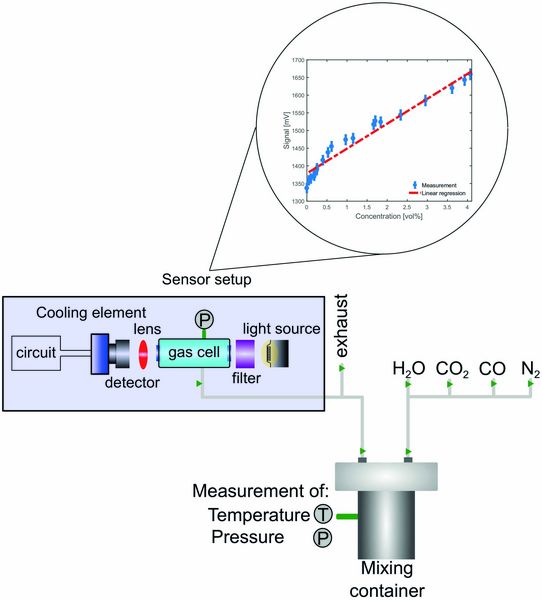
Schematic of the sensor setup. Left: The sensor based on NDIR spectroscopy is shown. The test gases with known concentrations are prepared in the mixing chamber. Inset: Measurement for CO. The sensor shows a linear behavior on the concentration.
Microplastics in sewage
In recent years, public attention is increasingly focussed on the topic of microplastic residues in water bodies. The reason for this is that the load on surface waters continues to rise and microplastics are detected in an increasing number of organisms of the food chain, which are also partly used for human consumption. The resulting health risks have not been explored yet. Methods for the enrichment and analysis of microplastic particles are neither standardized nor applicable for on-site analysis.
The aim of our work is the research and development of a practical on-site method for determining the mass of microplastic particles directly on filters. This method of determination is to be used in the monitoring of the effluent of sewage treatment plants.
The Raman method used is based on the scanning of the filter by means of a process Raman device. Therefore, no particles are counted but an average spectrum of all the particles present on the filter and the filter material are generated. The counting of individual particles and the Raman spectroscopic analysis of these particles requires the high apparatus-complexity of a Raman microscope, which is not practical in process analysis. Since the Raman spectrum of the loaded filter contains contribution from the Raman spectra of all substances on the filter and the filter material itself, a mathematical separation is necessary. For this purpose, the mathematical statistical method of partial least squares regression (PLS) is tested. A major challenge still remaining is to analyse and compensate the effects caused by the sample matrix.
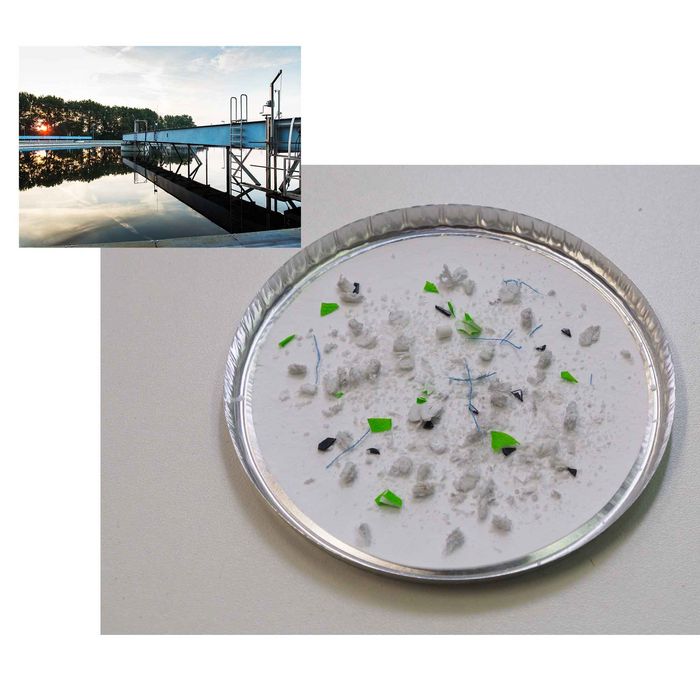
Microplastic residues found in sewage treatment plants.
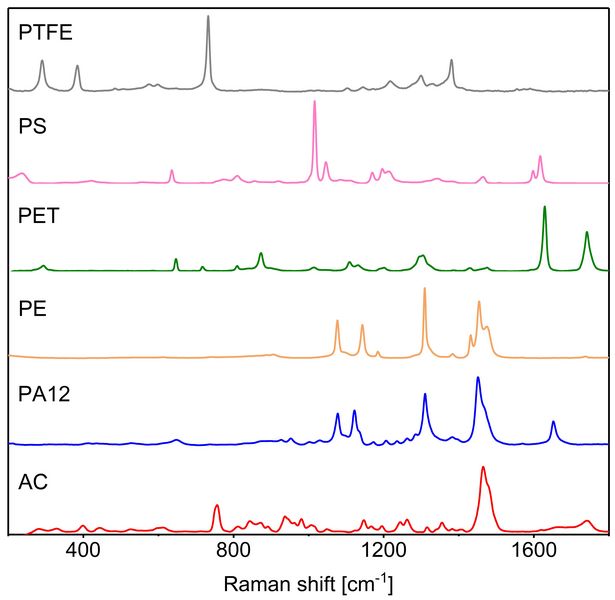
Raman spectra of acrylate-copolymer (AC), polyamide 12 (PA12), polyethylene (PE), polyethylenterephthalate (PET), polystyrole (PS) and polytetra uoroethylene (PTFE).
Laser-induced fluorescence for PAH determination
Over the last decade, our team developed different versions of a transportable UV-laser-fluorimeter with fibre optical probe for use in environmental and process analysis.
As light source a short-pulse up-converted diode-pumped Nd:YAG-laser with emission at 266 nm is used. The wavelength is perfect for the excitation of mono- (BTXE) and polycyclic aromatic hydrocarbons (PAH), as well as humic substances, aromatic amino acids and proteins.
Deploying optical waveguides out of quartz, the laser pulse is flexible guided to the measurement place for the excitation and the fluorescent emission is then guided back to the detection unit. Due to the special geometry of the fibres in the probe, the emission is collected efficiently and the entry of directed stray light is minimized.
The detection was implemented in different ways:
Time-dependent sequential, lifetime-resolved detection:
The fluorescence emission is spectrally fragmented and the spectra are detected at different times after the excitation pulse is emitted with a gated, intensified CCD-camera. Out of the obtained data, the spectrometer software builds up an emission-decay-spectrum.
Wavelength-dependent sequential, lifetime-resolved detection:
By applying a monochromator, a single emission wavelength can be chosen for which a high temporal resolved fluorescence decay curve can be detected. This is possible in deploying a time-correlated single photon counting technique. Out of several decay curves the software builds up an emission-decay-spectrum.
Integral fluorescence detection:
In combination with a diode line or CCD line array, the full fluorescence emission spectrum can be obtained. This setup is used, if the fluorescence decay times in the application are shorter than the decay of the instrument response function.
The control of all system versions is implemented with a self-developed spectrometer software. Furthermore, with this software a qualitative and quantitative data evaluation is feasible that ranges from simple linear one-component-regression over decay-time analysis to complex multi-component-analysis by deploying chemometric methods.
For feasibility studies the laserfluorimeters are placed at interested party’s disposal.
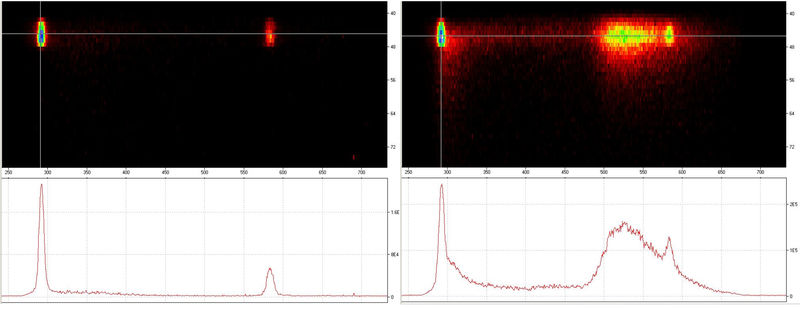
Sample analysis with the laser-fluorimeter. left: Ultrapure water. right: 30 µl Ibuprofen in Vitamin D-solution. The considerably changed fluorescent response is visible. The method enables the determination of small amounts of contaminants in water
Further information
Non-dispersive IR-absorption for emission testing
C. Niklas, Quantification of CO2 and CO concentrations via non-dispersive infrared spectroscopy, Master thesis, University of Göttingen and LLG, 18. July 2018.
Laser-induced fluorescence for PAH determination
F. Lewitzka, M. Niederkrüger, G. Marowsky:
„Application of Two-Dimensional LIF for the Analysis of Aromatic Molecules in water”, in P. Hering, J.P. Lay, S. Strey (Editors): „Laser in Environmental and Life Sciences”, 141-161, Springer Verlag, Berlin, 2003.
P. Karlitschek, F. Lewitzka, U. Bünting, M. Niederkrüger, G. Marowsky:
„Detection of aromatic pollutants in the environment using UV-laser-induced fluorescence“, Appl. Phys. B 67, 497-504, 1998
Funding:
DBU-Förderung „Entwicklung eines Laserfluorimeters zum Nachweis von organischen Schadstoffen in Wasser“ (1994-1996, Förderkennzeichen 01989).
BMBF-Förderprogramm Mikrosystemtechnik „BTXE und PAK Sensor“ (1996-1999, Förderkennzeichen 16SV558/0).
BMBF-Förderprogramm Mikrosystemtechnik „BTXE und PAK Sensor II“ (1999-2003, Förderkennzeichen 16SV1112/5).
Energy
The research of energy conversion processes has been studied at the Institut für Nanophotonik since its founding. Imaging techniques such as laser-induced fluorescence are used for mixture analysis of fuels inside the combustion chamber of internal combustion engines. A spark plug sensor based on non-dispersive IR absorption has been intensively investigated and developed further.
With it the concentration of liquid and gaseous fuel at the location of the spark plug can be determined. In addition to propulsion systems based on fossil fuels, the department is also engaged in the research of Li-ion batteries based on optical technologies.
Exhaust gas sensor for IC engines
A new European Union (EU) regulation on the control of CO2 emissions requires reducing the average emissions of new cars below 95 g/km by 2021. The use of compressed natural gas (CNG) as fuel allows significant reduction of the CO2 emissions and thus achieves the goal set by the EU.
The development of efficient and low-emission CNG-engines is a new challenge since the physical properties of CNG differ significantly from those of conventional liquid gasoline. This directly influences the mixture formation and the combustion process. Therefore, the time-resolved (100 μs) acquisition of data on the gas density of each substance (methane, water and carbon dioxide) involved in a motorcycle of a typical four-stroke engine is urgently required.
The department Photonic Sensor Technology established a collaboration with the Institute for Com-bustion and Gasdynamics Duisburg and the companies LaVision GmbH and Volkswagen AG on the solution to this problem in the OMeGa-E project ending in mid-2017.
During former projects, a spark-plug sensor based on IR-absorption to measure mixture formation in the combustion chamber of an engine was developed together with LaVision. This sensor was further developed in the OMeGa-E project for use with CNG air mixtures.
The results on a test engine at Volkswagen and a rapid compression machine at University Erlangen showed the functionality of the developed ICOS system. Based on this successful development, a commercial sensor is produced and sold by LaVision, with which CNG engines can be optimized and hence be manufactured more environmentally friendly.
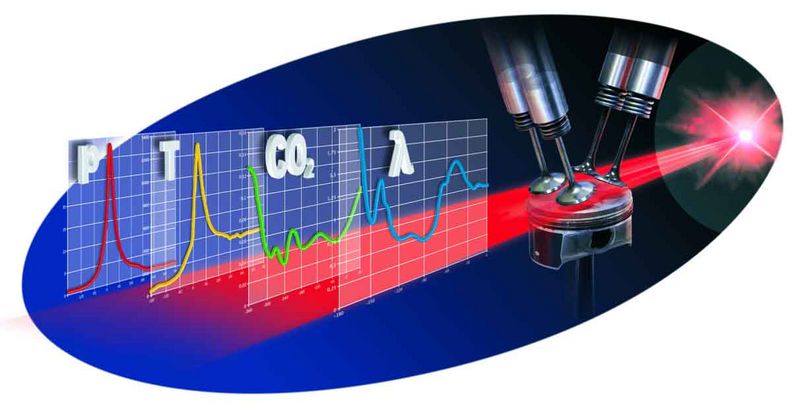
Measuring the density of CO2 and the lambda value together with pressure and temperature during an engine cycle give the possibility of an extensive analysis of the mixture formation. (source: LaVision GmbH)
Further information
Exhaust gas sensor for IC engines
P. Kranz, D. Fuhrmann, M. Goschütz, S. Kaiser, S. Bauke, K. Golibrzuch, H. Wackerbarth, P. Kawelke, J. Luciani, L. Beckmann, J. Zachow, M. Schuette, O. Thiele, T. Berg:
In-cylinder LIF imaging, IR-absorption point measurements, and a CFD simulation to evaluate mixture formation in a CNG-fueled engine, SAE Technical Paper 2018, 2018-01-0633, 2018.
S. Bauke, K. Golibrzuch, H. Wackerbarth, P. Fendt, L. Zigan, S. Seefeldt, O. Thiele, T. Berg:
Optical sensor system for time-resolved quantification of methane concentrations: validation measurements in a rapid compression machine, Journal of Quantitative Spectroscopy & Radiative Transfer, 210, 101-110, 2018.
K. Golibrzuch, F.-E. Digulla, S. Bauke, H. Wackerbarth, O. Thiele, T. Berg:
Optical sensor system for time resolved quantification of methane densities in CH4-fueled spark ignition engines, Applied Optics, 56 (22), 6049-6058, 2017.
S. Bauke, K. Golibrzuch, F. Rotter, H. Wackerbarth, O. Thiele, T. Berg:
Quantitative, time-resolved detection of CH4 concentrations in flows for injection analysis in CNG engines using IR absorption, Journal of Sensors and Sensor Systems, 6 (1), 185-198, 2017.
A. Grosch, H. Wackerbarth, O. Thiele, T. Berg, L. Beckmann:
Infrared spectroscopic concentration measurements of carbon dioxide and gaseous water in harsh environments with a fiber optical sensor by using the HITEMP database, Journal of Quantitative Spectroscopy & Radiative Transfer, 133, 106-116, 2014.
A. Grosch, V. Beushausen, H. Wackerbarth, O. Thiele, T. Berg, R. Grzeszik:
Calibration of mid-infrared transmission measurements for hydrocarbon detection and propane concentration measurements in harsh environments by using a fiber optical sensor, Journal of Quantitative Spectroscopy & Radiative Transfer, 112 (6), 994-1004, 2011.
Life Science
Life sciences are research directions that deal with processes or structures of living beings or in which living things are involved. For the department, the study of methods for medical diagnosis, the monitoring of biotechnological processes, and food research are the main fields of interest. In this respect, microfluidics as a sample preparation technology has proven to be effective. Here, a miniaturized free-flow electrophoresis chip for the separation of proteins with an optical read-out mechanism was explored.
Furthermore, a lateral flow test for veterinary medicine is being investigated. With it, cytokine detection in very low quantities is possible. The test is thereby based on surface-enhanced Raman spectroscopy. In the field of medical technology, we investigate the possibilities of a photonic sensor for the monitoring of infusion solutions on patients.
Inactivation of microorganisms on bulk materials
Manufacturers and suppliers of natural-based herbs, teas and spices, i.e. so-called organic products, often struggle with contamination from tiny or microorganisms such as fungi and bacteria or mites. These undesirable organisms damage the quality of the products and represent a health risk for the end customer as well as a reduction in shelf life. This is particularly true if multiplication occurs. Reducing these organisms can help. The methods used so far, such as steam or CO2 treatment, are inadequate or not suitable. Compatible with natural raw materials is inactivation by UV light or the still little-researched use of plasmas. The reaction mechanisms that result from such inactivation in connection with organic substances are partly known, but the specific impact on the products is not. This is where a project comes into play in which the IFNANO is responsible for examining such bioproducts before and after the microorganisms are deactivated by plasma or UV radiation. Gas chromatographic techniques will be used, as well as semiconductor sensors that can describe the outgassing behavior of the bioproducts. In addition, photographic processes including hyperspectral analysis should be used.
The work on this topic is co-financed by the state of Lower Saxony and supported by the European Union within the framework of an innovation project, for which we would like to thank you. The innovation project began on August 1, 2023 and will last 3 years. Funding as part of the European Innovation Partnership Agri supports cooperative innovation projects that provide impetus for a competitive, sustainable food industry. The aim is to promote innovation and improve the exchange of knowledge between science and agricultural practice.
- please refer to the website of our partner

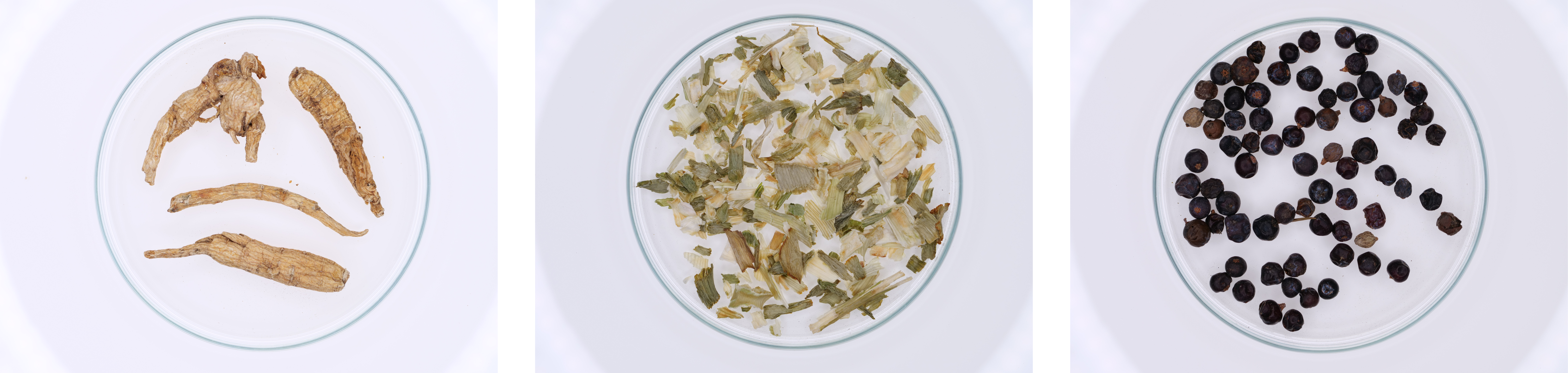
Example photos of ginseng root (left), leek (middle) and juniper berries (right).
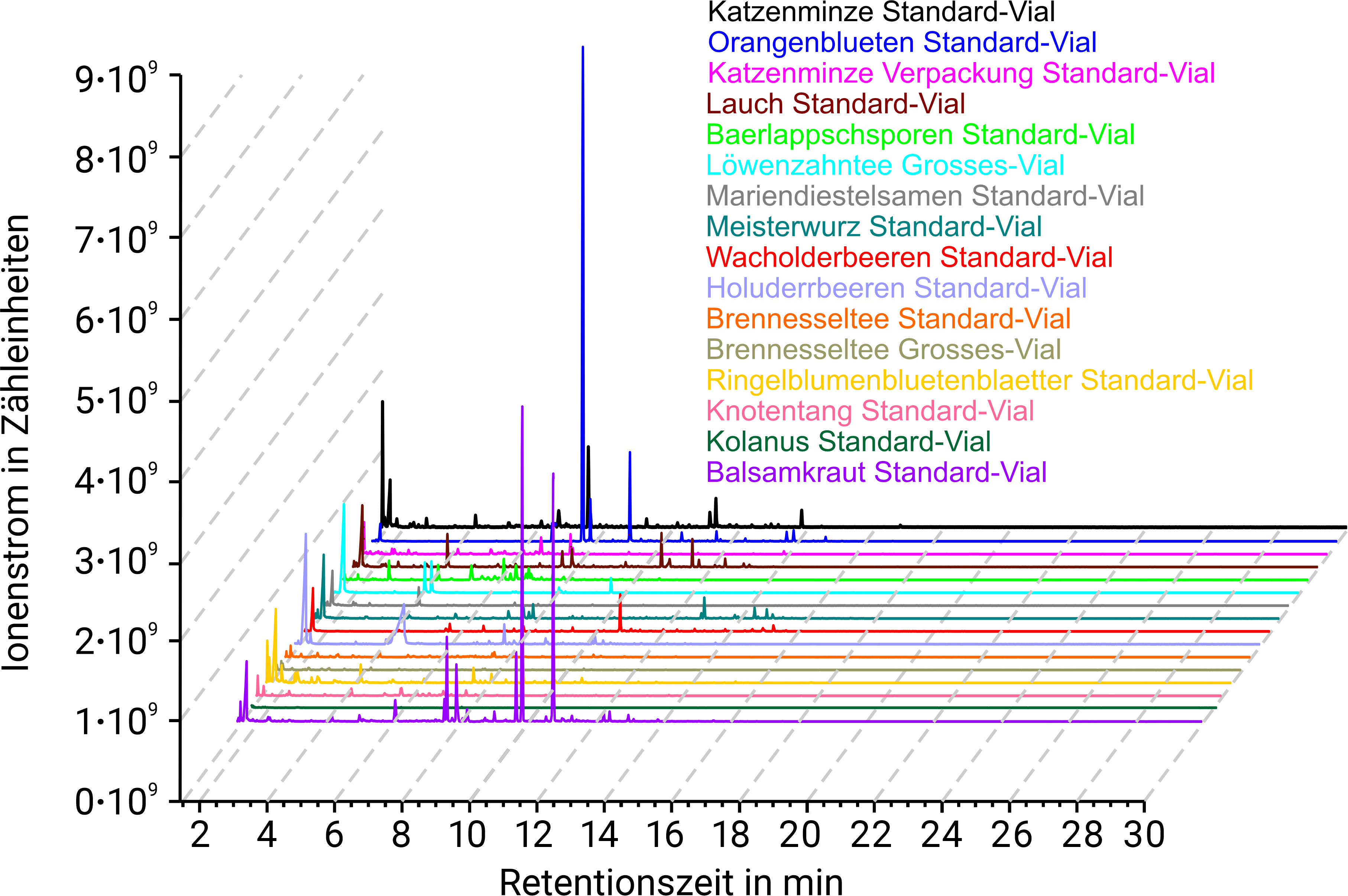
Chromatograms of bulk materials of various organic products.
Miniturized chip for free-flow-electrophoresis
For the detection and quantitative analysis of liquid mixture ingredients, for monitoring chemical and biological production and purification processes as well as for analytical procedures in medical diagnostics, the department Photonic Sensor Technology has developed a continuous online analysis and monitoring process. The current focus lies in the monitoring of protein production for pharmaceutical applications.
The method is based on the coupling of free-flow electrophoresis (µFFE), in which the components of a complex liquid mixture are separated, and an optical detection system, such as fluorescence or surface-enhanced Raman scattering (SERS). The detection system is highly sensitive and is used for the identification of the different molecular species being separated and enriched by µFFE.
The miniaturization of the FFE system has some advantages. In particular, μFFE-systems require only a few nanoliters to microliters of a sample, which makes the application in clinical analysis or protein production, where only small amounts of samples are available, particularly interesting. Another important advantage of miniaturization is the avoidance of heating due to the otherwise occurring high electrical currents. The chip is produced and sold by microfluidic ChipShop.
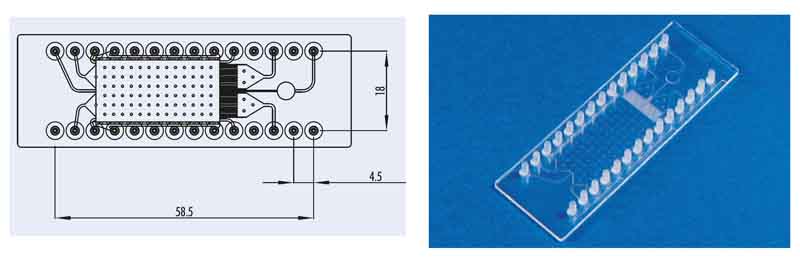
Schema and photo of the chip developed at the LLG (Source microfluidic ChipShop, Jena)
Further information
Miniturized chip for free-flow-electrophoresis
Walowski, B., Hüttner, W., Wackerbarth, H., Generation of a miniaturized free-flow electrophoresis chip based on a multi-lamination technique—isoelectric focusing of proteins and a single-stranded DNA fragment, Analytical and Bioanalytical Chemistry, 401, 2465-2471, 2011.
Hüttner, W., Christou, K., Göhmann, A., Beushausen, V., Wackerbarth, H., Implementation of substrates for surface-enhanced Raman spectroscopy for continuous analysis in an optofluidic device, Microfluid Nanofluid, 12 (1-4), 521-527, 2012.
Security and Process control
The objective of our research in the security sector is to protect people from the threats of natural disasters, major accidents, and terrorism. In the field of safety engineering, we are investigating new detection methods for explosives, thus making controls at, e.g., airports more reliable and effective. Another challenge is the chemical assessment of the state of health of ammunition in the sea.
Process control requires fast, non-destructive, selective, and sensitive measurement procedures. The processes should be robust, low-maintenance, and inexpensive. Optical methods are in principle very well suited for this.
Examples of this are the determination of moisture in matrices such as coffee using near-infrared spectroscopy and chemometry and the development of a device for the quantification of bitter substances in beers by means of absorbance measurement. These requirements are also met by ion mobility spectrometry, which has been researched and implemented for the monitoring of formaldehyde concentration in the production of wood-based materials.
Detection of explosives
Explosive detection is an actual and pressing issue. Surface enhanced Raman scattering (SERS) spectroscopy enables rapid, faultless detection of different classes of explosives including triacetone triperoxide (TATP). This explosive was, for example, used in the attacks in Paris in November 2015.
Traces of explosives on clothing or luggage are picked up with a fleece by means of the so-called wiping test. The fleece is heated to analyse the vaporizable components. The low amounts of the substances are a great challenge for Raman spectroscopy, which is as characteristic as a fingerprint.
The principle of thermal deposition is used to gather the explosive molecules on the plasmonic substrate. For this purpose, the nanostructured surface is located on a cooling finger. On to this, the substances to be analyzed, which have been baked out of the fleece by means of the thermal desorption unit, are redeposited in a minimal area. This process is also referred to as cryofocusing.
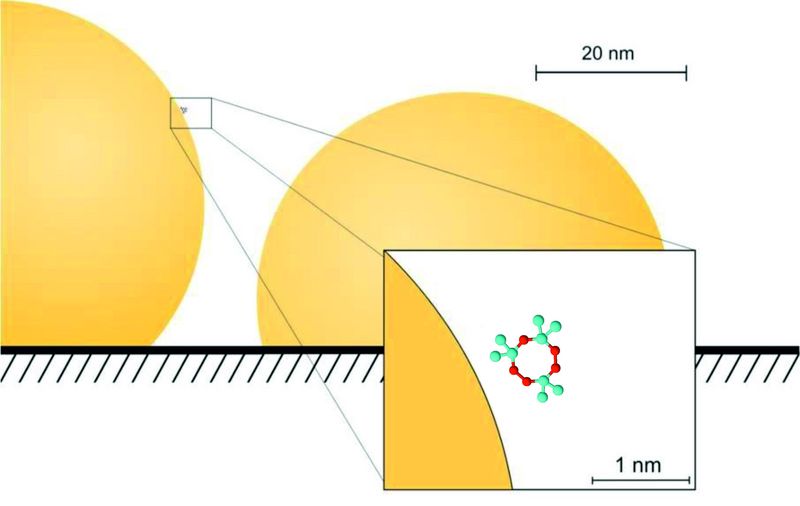
Schematic of a nano-structured plasmonic substrate with a TATP molecule adsorbed at the surface.
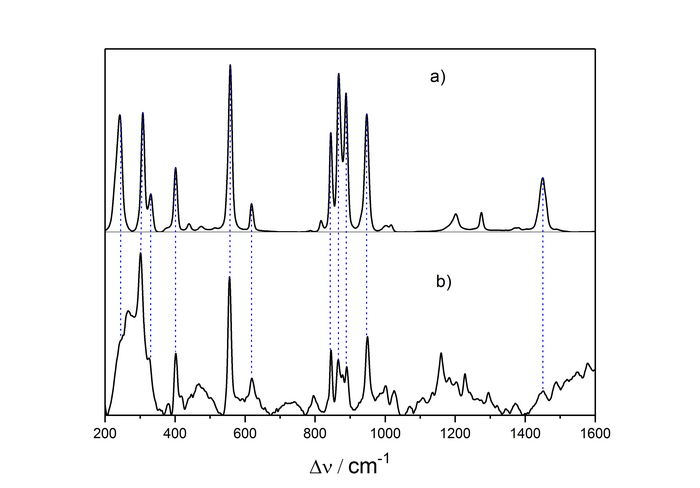
Raman spectra of TATP recorded on bulk material (a) and traces (nanogramme amount) at a plasmonic surface (b).
Further information
Explosive detection
H. Wackerbarth, C. Lenth, S. Funke, L. Gundrum, F. Rotter, F. Büttner, J. Hagemann, M. Wellhausen, U. Plachetka, C. Moormann, C. Strube, A. Walte:
Surface enhanced vibrational spectroscopy for the detection of explosives, Proc. SPIE, 8896, art. no. 889609, 2013.
H. Wackerbarth, L. Gundrum, C. Salb, K. Christou, W. Viöl:
Challenge of false alarms in nitroaromatic explosive detection—a detection device based on surface-enhanced Raman spectroscopy, Applied Optics, 49 (23) 4367-4371, 2010.
H. Wackerbarth, C. Salb, L. Gundrum, M. Niederkrüger, K. Christou, V. Beushausen, W. Viöl:
Detection of explosives based on surface-enhanced Raman spectroscopy, Applied Optics, 49 (23) 4362-4366, 2010.
Plasmonic substrates
J. Barnett, U. Plachetka, C. Nowak, H. Wackerbarth:
Highly periodic Au nano-disc arrays for plasmon resonance-controlled SERS structures on fused silica using UV-NIL based double-layer lift-off process, Microelectronic Engineering, 172, 45-48, 2017.
S. Funke, H. Wackerbarth:
The role of the dielectric environment in surface enhanced Raman scattering on the detection of a 4-Nitrothiophenol monolayer, J. Raman Spectrosc., 44 (7), 1010-1013 2013.
K. Christou, I. Knorr, J. Ihlemann, H. Wackerbarth, V. Beushausen:
Fabrication and Characterization of Homogeneous SERS-Substrates by Single Pulse UV-Laser Treatment of Gold and Silver Films, Langmuir, 26 (23), 18564-18569, 2010.
Products and services
- Are you searching for solutions for measurement problems?
- Do you wish for a service provider that converts your budget for research and development reliably to customer-oriented solutions?
- Do you have an urgent need for a prototype built specifically for your requirements?
The physicists, chemists and engineers in our team hold extensive knowledge, competence and technical abilities in the field of optical sensing and place it at your disposal. We are very experienced in the fields of industrial research and development.
We would be pleased to advise and accompany you in the whole process of finding, from general consulting in measurement techniques, the elaboration of feasibility studies over performing of on-site measurement campaigns and leasing of special, client-specific measurement equipment to the development of measurement techniques and prototypes.
Our team is ready for every challenge.
Contact us!
We are looking forward to develop customized solutions for your problems.
Contact person:
Head of Department
Dr. Hainer Wackerbarth
“Photonic Sensor Technologies”
Tel.: +49(0)551/5035-58
Fax: +49(0)551/5035-99
hainer.wackerbarth@ifnano.de
Staff members

Dr. Hainer Wackerbarth
Head of department
E-Mail: hainer.wackerbarth@ifnano.de
Tel.: +49 551 5035-58

Dr. Georgios Ctistis
Staff member
E-Mail: georgios.ctistis@ifnano.de
Tel.: +49 551 5035-27



Publications
Publications
- F. B. Müller, G. Ctistis:
Quantifying stress states of theoretically modeled polarimetric measurements on dielectric media, Physical Review Applied 24, 034035 (2025), doi: 10.1103/rh94-jdw2 - G. Marowsky, F. Wieduwilt, J. Holburg, L. Lakemann, S. Figul:
Innovative liquid flat-jet system for microfluidic applications in vacuum, Proc. of SPIE 13312, 1331202 (2025) - F. Wieduwilt, J. Geweke, F. Merker-Müller, H. Linxweiler, R. M. Heeb, G. Ctistis, H. Wackerbarth:
Enhancing safety for infusion treatment in oncology through a data-driven multisensory approach based on optical methods, Proc. SPIE 13316, 1331609 (2025)
Conference constributions
- F. Wieduwilt, J. Geweke, F. Merker-Müller, H. Linxweiler, R. M. Heeb, G. Ctistis, H. Wackerbarth:
Enhancing safety for infusion treatment in oncology through a data-driven multisensory approach based on optical methods, Optical Diagnostics and Sensing XXV: Toward Point-of-Care Diagnostics, SPIE Photonics West, San Francisco, USA (01.2025) - G. Marowsky, F. Wieduwilt, J. Holburg, L. Lakemann, S. Figul:
Innovative liquid flat-jet system for microfluidic applications in vacuum“, SPIE Photonics West 2025, San Francisco, USA (01.2025) - V. Reimer, G. Ctistis, K. Fedorov, D. Theodoridis, P. Guehlke, C. Waltermann, J. Koch, W. Schippers:
Fiber Optical Point-of-Care Fluorescence Reader, European Conference on Biomedical Optics, Munich (06.2024) - F. Wieduwilt, J. Geweke, F. Merker-Müller, G. Ctistis, H. Wackerbarth:
Identification of Critical Care Medications: Optical Approaches, Raman Fest, Frankfurt (07.2025) - F. Müller, H. Wackerbarth, G. Ctistis:
Quantifiable surface stress evaluation of dielectric materials, e.g. glass, using contactless reflection polarimetry, SPIE optics and Photonics, San Diego, USA (08.2025) - P. Schröder, H. Wackerbarth, G. Ctistis:
Hyperspectral Flourescence Reader for Lateral Flow Tests, SPIE Optics and Photonics, San Diego, USA (08.2025) - J. Geweke:Photonische Verfahren für Point-of-Care-Anwendungen, 11. Partnerschafts-symposium „Plasma for Life“, Göttingen (09.2025)
- C. Lenth, S. Pagel-Wieder, H. Wackerbarth:
Multiplex Tests in POC Analysis: A Combination of Lateral Flow Assay and Paper-Based Color Change Test for the Assessment of Inflammatory Processes in Cows, ANAKON, Leipzig (03.2025) - H. Wackerbarth, Q. Song, Y. Cai, F. Wieduwilt, P. Vana:
Gold Nanostars – Satellite Nanolabels for Surface-Enhanced Raman Spectroscopy, Raman-Fest, Frankfurt (07.2025) - C. Lenth, A. Schumann, F. Ude, H. Wackerbarth:
A Field-Deployable GC–IMS Method for the On-Site Detection of Sulfur Mustard and Its Degradation Products in Marine Sediments, 34th International Conference on Ion Mobility Spectrometry, Berlin (08.2025)
Publications
- P. B. Aschemann, P.‐F. Hagen, S. Albers, R. Rofallski, S. Schwabe, M. Dagher, M. Lukas, S. Leineweber, B. Klie, P. Schneider, H. Bossemeyer,
L. Hinz, M. Kästner, B. Reitz, E. Reithmeier, T. Luhmann, H. Wackerbarth, L. Overmeyer, U. Giese:
Smart Rubber Extrusion Line Combining Multiple Sensor Techniques for AI‐Based Process Control, Adv. Eng. Mater. 2401316 (2024) - B. Klie, S. Schwabe, C. Lenth, U. Giese, H. Wackerbarth:
Conversion of an industrial LIBS system to double-pulse operation to improve sulphur detection in rubber-based parts, Spectrochim. Acta B 106923 (2024). - F. Wieduwilt, J. Geweke, F. Merker-Müller, G. Ctistis, H. Wackerbarth:
- Analysis of infusion solutions using a multisensory approach consisting of Raman spectroscopy, refractometry, and UV/Vis spectroscopy to prevent medication errors, Proc. SPIE 13008, Biophotonics in Point-of-Care III, 130080I (2024)
- F. Müller, H. Wackerbarth, G. Ctistis:
Mapping surface stress of automotive glass by non-contact polarimetric scans, Proc. of SPIE 12950, 129500Q (2024) - C. Lenth, H.Wackerbarth:
Senfgasanalytik für Munitionsaltlasten im Meer, GIT-Laborfachzeitschrift 8, 45-47 (2024) - C. Lenth, H. Wackerbarth:
Senfgasanalytik für Munitionsaltlasten im Meer, Wiley Analytical Science newsletter, https://analyticalscience.wiley.com
Conference constributions
- C. Lenth, A. Schumann, F. Ude, H. Wackerbarth:
Eine neuartige Probenahmetechnik basierend auf Ionenmobilitätsspektroskopie, Gaschromatographie und Festphasenextraktion zur Bestimmung von S-Lost in Meeresböden, IMS – Anwender*Innentreffen 2024, Innsbruck (03.2024) - M. Müller, H. Wackerbarth, G. Ctistis:
Evaluation of optical anisotropy on the surface of stressed glass using a reflective polarimetric setup, Annual Spring Meeting of the German Physical Society: Section Solid State Matter, Berlin (03.2024) - M. Merker-Müller, H. Wackerbarth, G. Ctistis: Mapping surface stress of automotive glass by non-contact polarimetric scans, SPIE Smart Structures and Nondestructive Evaluation, Long Beach (03.2024)
- F. Wieduwilt, J. Geweke, F. Merker-Müller, G. Ctistis, H. Wackerbarth:
Analysis of infusion solutions using a multisensory approach consisting of Raman spectroscopy, refractometry, and UV/Vis spectroscopy to prevent medication errors, SPIE Photonics Europe, Strasbourg (04.2024) - F. Song, F. Wieduwilt, Y. Cai, P. Vana:
Gold Nanostar-satellite Nanoprobes for Surface Enhanced Raman Spectroscopy, 19th European Student Colloid Conference, Bordeaux (06.2024) - Y. AlSalka, J. Geweke, P. Schröder, C. Lenth, S. Schwabe, H. Wackerbarth:
Digitalization of quality control in incoming goods inspection in the rubber industry using photonic sensors, DKT 2024 – German Rubber Conference, Nürnberg (07.2024) - S. Schwabe, B. Klie, P. Schröder, A. Aschemann, M., Dagher, C. Lenth, H. Wackerbarth, U. Giese:
Static and in-line distribution quality assessment of crosslinking chemicals in rubber production intermediates by double-pulse LIBS, DKT 2024 – German Rubber Conference, Nürnberg (07.2024) - C. Lenth, A. Schumann, F. Ude,H. Wackerbarth:
A novel sampling technique based on SPME/GC for degeneration products of sulphur mustard in seabed, Wasser 2024, Limburg/Lahn (05.2024) - J. Geweke, Y. AlSalka, P. Schröder, C. Lenth, S. Schwabe, H. Wackerbarth:
Digitalisierung der Qualitätskontrolle von Kautschuken, MaterialDigital Vollversammlung 2024, Berlin (09.2024) - S. Schwabe, P. Schröder, M. Dagher, H. Wackerbarth:
Inline-Qualitätsüberwachung am Extrudat & Prozessautomatisierung, MaterialDigital Vollversammlung 2024, Berlin (09.2024) - M. Dagher, C. Lenth, H. Wackerbarth:
Innovative Raman Measurement Technique with a Uniform Line Focus for LFT readout, Raman Fest 2024, Paris (11.2024)
Publications
- W. Ramadan, Y. AlSalka, O. Al-Madanat, D. W. Bahnemann:
Synthesis of Magnetic Ferrite and TiO2-Based Nanomaterials for Photocatalytic Water Splitting Applications. In: Uddin, I., Ahmad, I. (eds) Synthesis and Applications of Nanomaterials and Nanocomposites. Composites Science and Technology . Springer, Singapore. - M. Curti, Y. AlSalka, O. Al-Madanat, D. W. Bahnemann:
Isotopic Substitution to Unravel the Mechanisms of Photocatalytic Hydrogen Production. In Photocatalytic Hydrogen Production for Sustainable Energy, A. Puga (Ed.) (2023) - C. Lenth, A. Schumann, F. Ude, H. Wackerbarth:
On-site detection method for sulfur mustard for safe underwater work, 2023, Anakon 2023 Book of Abstracts, 161, ISBN 978-3-200-09056-9.
Conference constributions
- C. Lenth, A. Schumann, F. Ude, H. Wackerbarth:
On-site detection method for sulfur mustard for safe underwater work, Anakon, Wien (04.2023). - T. Kutz, C. Niklas, J. Koch, W. Schippers, H. Wackerbarth, G. Ctistis:
Detection of Environmental Gas Compositions with Shifted-excitation Fiber-enhanced Raman Difference Spectroscopy, Optica Sensing Congress, München (08.2023) - Y. AlSalka, S. Schwabe, J. Geweke, G. Ctistis, C. Lenth, P. Schröder, H. Wackerbarth:
Resource quality control for rubber production and in-line analysis, FEMS EUROMAT 23, Frankfurt a. Main (09.2023) - Y. AlSalka:
Inline & offline spectroscopy in the field of photocatalytic and photoelectrochemical energy applications, Inno-Forum Workshop “Electrochemistry”, Tunesien (05.2023)
Publications
- K. Golibrzuch, S. Schwabe, T. Zhong, K. Papendorf, A. M. Wodtke:
Application of an Event-Based Camera for Real-Time Velocity Resolved Kinetics, J Phys Chem A 126, 2142-2148 (2022) - K. Papendorf, K. Golibrzuch, T. Zhong, S. Schwabe, T. Kitsopoulos, A. M. Wodtke:
Velocity-resolved Laser-induced Desorption for Kinetics on Surface Adsorbates, Chem Methods 2, e202200017 (2022) - F. Wieduwilt, J. Grünewald, G. Ctistis, C. Lenth, T. Perl, H. Wackerbarth:
Exploration of an Alarm Sensor to Detect Infusion Failure Administered by Syringe Pumps, Diagnostics 12(4), 936 (2022)
Conference constributions
- C. Lenth, A. Schumann, H. Wackerbarth:
Neue Wege zur Kampfstoffanalytik mittels der Kopplung von Gaschromatographie und Ionenmobilitätsspektroskopie, 9. IMS-Anwendertreffen, Unna (03.2022) - T. Kutz, C. Niklas, H. Wackerbarth, G. Ctistis:
Fibre enhanced Raman spectroscopy for detecting atmospheric and (climate) harmful gases, SPIE Photonics Europe, Strasbourg, France (04.2022) - G. Ctistis:
Nanoparticles and plasmonics for sensing applications, CINSaT autumn colloquium 2022, Kassel (11.2022) - F. Wieduwilt, G. Ctistis, T. Kutz, I. Aleknavičienė, H. Wackerbarth:
Evaluation of Stochastically Produced Plasmonic Surface Structures for SERS Application, CINSaT spring colloquium 2022, Friedrichroda (03.2022) - G. Ctistis, C. Niklas, H. Wackerbarth:
Confocal Raman spectromicroscopy for submicron spatial temperature determination, SPIE Photonics Europe, Strasbourg, France (04.2022) - F. Wieduwilt, G. Ctistis, T. Kutz.I. Aleknavičienė, H. Wackerbarth:
Wavelength-dependent SERS hot spot localization of stochastically generated plasmonic nanostructures, CINSaT autumn colloquium 2022, Kassel (11.2022)
Publications
- F. Diao, W. Huang, G. Ctistis, H. Wackerbarth, Y. Yang, P. Si, J. Zhang, X. Xiao, C. Engelbrekt:
Bifunctional and Self-Supported NiFeP-Layer-Coated NiP Rods for Electrochemical Water Splitting in an Alkaline Solution, ACS Applied Materials and Interfaces 13 (20), 23702 (2021) - C. Niklas, H. Wackerbarth, G. Ctistis:
A Short Review of Cavity-Enhanced Raman Spectroscopy for Gas Analysis, Sensors 21, 1698 (2021) - Y. AlSalka, O. Al-Madanat, A. Hakki, D. W. Bahnemann:
Boosting the H2 Production Efficiency via Photocatalytic Organic Reforming: The Role of Additional Hole Scavenging System, Catalysts 1(12), 1423 (2021) - O. Al-Madanat, B. N. Nunes, Y. AlSalka, A. Hakki, M. Curti, A. O. Patrocinio, D. W. Bahnemann:
Application of EPR Spectroscopy in TiO2 and Nb2O5 Photocatalysis, Catalysts (revised submitted / Manuscript ID: catalysts-1468319) - H. Wackerbarth, C. Lenth, G. Ctistis, F. Wieduwilt, N. Konradt:
Bestimmung von Benzotriazol in Gewässern mit plasmonischer on-site Analytik, GdCh – Mitt Umweltchem Ökotox, Heft 4 (2021Konferenzbeiträge - J. Kratz, F. Wieduwilt, M. Saveliev, C. Javelle:
Methods and components to mitigate the radioactive aerosol contamination risks for the Chernobyl NSC, Sixth International Conference on Nuclear Decommissioning and Environment Recovery – INUDECO 2021, Slavutych, Ukraine ISBN 978-617-7932-10-8, S.10-12 (04.2021) - J. Kratz, F. Wieduwilt, M. Saveliev:
Pillars for establishing a durable and future-proof IT architecture maturing along with the NSC: Approaches from Continuous Integration to Service Mesh, Mathematical Modeling and Simulation of Systems – MODS 2021, Chernihiv, Ukraine (06.2021) - C. Lenth, M. Dinse, A. Schumann:
Brandfrühwarnsystem auf Basis der Ionenmobilitätsspektrometrie für Lithium-Ionen-Akkumulatoren – 8. IMS Anwendertreffen, Potsdam (03.2021) - F. Wieduwilt, J. Grünewald, H. Wackerbarth:
Evaluation of an optical multisensor system for monitoring pharmaceuticals in hospital and pharmacy environments, CINSaT autumn colloquium 2021, Kassel (11.2021)
Publications
- F. Wieduwilt, C. Lenth, G. Ctistis, U. Plachetka, M. Möller, H. Wackerbarth: Evaluation of an on-site surface enhanced Raman scattering sensor for benzotriazole. Sci. Rep. 10, 8260, (2020)
Raman spectroscopy of atmospheric gases using hollow core photonic crystal fibres, Proc. SPIE 11354, Optical Sensing and Detection VI,113540O, (2020) - C. Lenth, F. Wieduwilt, G. Ctistis, H. Wackerbarth:
SERS-Spektroskopie in der Abwasseranalytik – Analyse von Abwasserproben auf Diclofenac und Benzotriazol, GIT Labor-Fachzeitschrift, S. 29-21, (18.05.2020)
Conference constributions
- Wackerbarth, C. Lenth, F. Wieduwilt, B. Wedemeyer, G. Ctistis:
Raman-basierte Verfahren zur Analyse von Mikroplastiken, Diclofenac und 1H-Benzotriazol in Wasser, S.122-127, Wasser 2020, Potsdam (05.2020)
Publications
- C. Niklas, G. Ctistis, F. Müller, H. Wackerbarth:
Ramanspektroskopie mit photonischen Hohlkernfasern am Beispiel atmosphärischer Gase, Sensoren und Messsysteme 2019, Nürnberg, Deutschland (06.2019) - C. Lenth, F. Wieduwilt, G. Ctistis, J. Banett, U. Plachetka, H. Wackerbarth:
Vor-Ort-Analytik von 1-H-Benzotriazol auf Basis der oberflächenverstärkten Raman-Spektroskopie, ANAKON 2019, Münster, Deutschland (03.2019) - H. Wackerbarth:
Raman-basierte Techniken im Bereich Patientensicherheit und medizinischer Diagnostik, 12. Workshop Kleine Volumenströme in der Medizintechnik, Lübeck, (06. 2019) - G. Ctistis, C. Niklas, F. Müller, H. Wackerbarth:
Quantitative measurement of CO2 with non-dispersive infrared absorption spectroscopy, DPG-Frühjahrstagung 2019, Rostock, Deutschland (03.2019) - F. Wieduwilt, C. Lenth, U. Plachetka, H. Wackerbarth:
Detektion von Arzneimitteln in Abwässern durch oberflächenverstärkte Raman-Spektroskopie, ANAKON 2019, Münster, Deutschland (03.2019)
Publications
- S. Bauke, K. Golibrzuch, H. Wackerbarth, P. Fendt, L. Zigan, S. Seefeldt, O. Thiele, T. Berg:
Optical sensor system for time-resolved quantification of methane concentrations: validation measurements in a rapid compression machine, Journal of Quantitative Spectroscopy & Radiative Transfer, 210, 101-110, 2018. - P. Kranz, D. Fuhrmann, M. Goschütz, S. Kaiser, S. Bauke, K. Golibrzuch, H. Wackerbarth, P. Kawelke, J. Luciani, L. Beckmann, J. Zachow, M. Schuette, O. Thiele, T. Berg:
In-cylinder LIF imaging, IR-absorption point measurements, and a CFD simulation to evaluate mixture formation in a CNG-fueled engine, SAE Technical Paper 2018, 2018-01-0633, 2018. - C. Niklas, S. Bauke, G. Ctistis, K. Golibrzuch, H. Wackerbarth:
Non-dispersive IR-spectroscopy in harsh environments, Sensoren und Messsysteme 2018, Nürnberg, Deutschland (06.2018) - F. Wieduwilt, S. Göllner, G. Ctistis, C. Lenth, H. Wackerbarth:
Evaluation von plasmonischen Strukturen für die Detektion von Arzneimittelrückständen,
Umwelt 2018, Münster, Deutschland (09.2018) - F. Wieduwilt, C. Lenth, U. Plachetka, H. Wackerbarth:
Herstellung und Charakterisierung von funktionellen Oberflächen für die Bioanalytik,
19. Heiligenstädter Kolloquium, Heilbad Heiligenstadt, Deutschland (09.2018), ISBN 978-3-00-0606546-4 (2018) - F. Wieduwilt, C. Lenth, U. Plachetka, H. Wackerbarth:
SERS als Möglichkeit zur Überwachung von Oberflächenfunktionalisierungen, Kaiser-Friedrich-Forschungspreis, Goslar, Deutschland (10.2018)
Publications
- K. Golibrzuch, F.-E. Digulla, S. Bauke, H. Wackerbarth, O. Thiele, T. Berg:
Optical Sensor System for Time-Resolved Quantification of Methane Densities in Methane-fueled Spark Ignition Engines, Applied Optics, 56 (22), 6049-6058, (2017) - J. Barnett, U. Plachetka, C. Nowak, H. Wackerbarth:
Highly periodic Au nano-disc arrays for plasmon-resonant SERS structures on fused silica using UV-NIL based double-layer lift-off process, Microelectronic Engineering, 172, 45-48 (2017) - S. Bauke, K. Golibrzuch, F. Rotter, H. Wackerbarth, O. Thiele, T. Berg:
Quantitative, time-resolved detection of CH4 concentrations in flows for injection analysis in CNG engines using IR absorption, Journal of Sensors and Sensor Systems, 6(1), 185-198 (2017)
Conference constributions
- S. Bauke, K. Golibrzuch, H. Wackerbarth, O. Thiele, T. Berg:
Quantitative, Time-Resolved Detection of CH4 in Flows using IR Absorption, 18. GMA/ITG-Fachtagung Sensoren und Messsysteme 2016, doi: 10.5162/sensoren2016/6.2.5, ISBN: 978-3-9816876-0-6 (2016) - S. Bauke, K. Golibrzuch, H. Wackerbarth, O. Thiele, T. Berg, L. Beckmann, N. Hübner, J. Zachow:
Optical measurement system for quantitative, time-resolved detection of CNG mixture formation in an SI engine; 11. Tagung Gasfahrzeuge, Potsdam (09.2016) - H. Wackerbarth:
Applied Optics and Lab on Chip, Lab-on-a-chip Symposium (invited talk), Enschede, Niederlande, (06.2016) - H. Wackerbarth:
SERS, Raman und IR Spektroskopie, PPA-Seminar Gasanalytik und Gefahrstoffdetektion (eingel. Vortrag), Schwerin (04.2016) - H. Wackerbarth:
Photonische Analytik in Verbrennungsdiagnostik, Umweltanalytik und Sicherheitstechnik, Weiterbildungsseminar PhotonicNet „Technische Optik in der Praxis“ (eingel. Vortrag), Göttingen (09.2016) - K. Golibrzuch:
Optical Diagnostics for Combustion Analysis and Surface Kinetics, 2nd International Forum on Metrology for Liquefied Natural Gas (LNG) & Alternative Fuels (04.2016) - K. Golibrzuch:
Cavity-Enhanced Raman-Spektroskopie für Prozessanalytik (CERS-Pro), F.O.M.-Jahreskonferenz (11.2016) - S. Steinhauer, U. Plachetka, J. Barnett, H. Wackerbarth, C. Lenth, J. Born, M. Liebetrau, A. Walte, B. Ungethüm, G. Pelzer, H. Thole:
Vor-Ort-Überwachung von Arzneirückständen, Mikro- und Nanopartikeln im Ablauf städtischer Kläranlagen mittels photonischer Verfahren (VAMINAP), Poster zum Statustreffen des BMBF Förderprogramms „Photonik in den Lebenswissenschaften“ (09.11.2016)
Publications
K. Golibrzuch, J.H. Baraban, P. R. Shirhatti, J. Werdecker, C. Bartels, A. M. Wodtke:
Observation of Translation-to-Vibration Excitation in Acetylene Scattering from Au(111): A REMPI Based Approach, Z. Phys. Chem. 229, 1929-1949 (2015)
H. Wackerbarth:
„SERS, Raman und IR Spektroskopie“
Seminar des Netzwerks für Produkt- und Prozesssicherheit mittels spektroskopischer Analytik (PPA) zum Thema: „Möglichkeiten und Anwendungen der SERS/RAMAN-Spektroskopie“ Göttingen (06.05.2015)
M.Wellhausen:
„Untersuchung zum Einfluss der Struktur und des Materials auf die oberflächenverstärkte Infratrot-Absorption“
Technische Universität Berlin (16.12. 2015)
H. Wackerbarth, B. Walowski, J. Bertram:
“Fluorescence immunoassay in a μFFE-chip”, Deutsches BioSensor Symposium, TU München (11-13.03. 2015)
Publications
- M. Frank, S. Funke, H. Wackerbarth, G. H. Clever:
SERS spectroscopic evidence for the integrity of surface-deposited self-assembled coordination cages, Physical Chemistry Chemical Physics, DOI: 10.1039/C4CP02188F (2014) - A. Grosch, H. Wackerbarth, O. Thiele, T. Berg, L. Beckmann:
Infrared spectroscopic concentration measurements of carbon dioxide and gaseous water in harsh environments with a fiber optical sensor by using the HITEMP database, Journal of Quantitative Spectroscopy & Radiative Transfer, 133, 106-116 (2014) - S. Himmel, C. Mai, A. Schumann, J. Hasener, V. Steckel, C. Lenth:
Determination of formaldehyde release from wood-based panels using SPME-GC-FAIMS, Int. J. Ion Mobil. Spec. 17:55–67 (2014) - C. Lenth, A. Schumann, J. Hasener, V. Steckel, S. Himmel, C. Mai:
Developing a new method of measuring formaldehyde emissions from wood based panels, International Wood Products Journal, DOI: 10.1179/2042645314Y.0000000076 (2014)
Conference constributions
- S. Funke, H. Wackerbarth:
Tuning the Enhancement of a Plasmonic Substrate by the Dielectric Environment, International Conference on Raman Spectroscopy, (08.2014) - H. Wackerbarth, S. Hamler, S. Funke, C. Lenth, W. Hüttner, M. Wellhausen, J. Hagemann, L. Gundrum, U. Plachetka:
Generation of Plasmonic Substrates and Their Applications in Explosive Detection and Lab on a Chip Devices, International Conference on Raman Spectroscopy, (08.2014) - M. Wellhausen, H. Wackerbarth:
Evaluation of Structures and Material for Surface Enhanced IR Absorption, Surface Enhanced Spectroscopies, Chemnitz, August 2014 - H. Wackerbarth, S. Hamler, S. Funke, C. Lenth, W. Hüttner, M. Wellhausen, J. Hagemann, L. Gundrum, U. Plachetka:
Applications of Plasmonic Substrates and in Explosive Detection and Chip Devices, Surface Enhanced Spectroscopies, Chemnitz, August 2014
Cooperations
Industrial cooperation partners
- Airsense Analytics GmbH
- Analytik Jena AG
- B.Braun Melsungen AG
- Bosch AG
- Bruker Optik GmbH
- Fassis GmbH
- Fagus-GreCon Greten GmbH & Co. KG
- Frank Optic Products GmbH optische Technologien (FOP)
- GeSiM – Gesellschaft für Silizium-Mikrosysteme mbH
- Glunz AG
- HKS Sicherheitsservice GmbH
- IBA GmbH
- Innos Sperrlich GmbH
- LaVision GmbH
- microfluidic ChipShop GmbH
- Micromata GmbH
- miprolab GmbH
- Polytec GmbH
- Sartorius Stedim Biotech GmbH
- Schumann Analytics / Schumann Analytische Messtechnik
- Stadtwerke Düsseldorf AG
- Volkswagen AG
Institutional cooperation
- AIDIMA, Technology Institute Furniture Wood and Packaging
- AMO GmbH
- Bundeskriminalamt
- Danmarks Tekniske Universitet, Institut for Kemi
- Danmarks Tekniske Universitet, Institut for Mikro- og Nanoteknologi
- DLR Institut für Aerodynamik und Strömungstechnik
- Ecole Supérieure du Bois Institut technologique
- Fraunhofer-Institut für Angewandte Optik und Feinmechanik
- Institut für Anorganische Chemie Georg-August-Universität Göttingen
- Institut für Angewandte Biotechnologie, Georg-August-Universität Göttingen
- Hochschule für angewandte Wissenschaft und Kunst
- Institut für Lebensmitteltechnik und Qualitätssicherung e.V. Köthen
- Karlsruher Institut für Technologie,Institut für Mikroverfahrenstechnik
- Leibniz Universität Hannover,Institut für Technische Verbrennung (ITV)
- Material Forschungs- und Prüfanstalt an der Bauhaus-Universität Weimar (MFPA)
- Universität Göttingen, Fakultät für Forstwissenschaften & Waldökologie
- Technische Universität Berlin, Institut für Chemie
- Technische Universität Clausthal, Institut für Energieforschung und Physikalische Technologien
- Universität Leipzig, Institut für Analytische Chemie
- Universität Duisburg-Essen, Institut für Verbrennung und Gasdynamik
- Universität Duisburg-Essen, Fakultät für Chemie, Analytische Chemie
- University of Strathclyde, Centre for Molecular Nanometrology